Friday, May 23, 2014

The double message

Frank Auerbach Self Portrait
sold for £423,700 in 2008
In a letter to The Times in 1971 Frank Auerbach wrote: "Your correspondents tend to write of paintings as objects of financial value or passive beauty. For painters they are source material; they teach and they set standards." And this is much the same thing as T. S. Eliot meant when he wrote - in the September 1919 issue of The Egoist - that the poet "must inevitably be judged by the standards of the past"

Jacob Bronowski, as always, gives the wide-angle view: "The characteristic feature of all human cultures is that they make artifacts and this is really what we mean when we sat that the human mind is creative. The artifacts begin as simple stone tools, some of which are at the least several hundred thousand years old. What characterizes these and later artifacts is the double message that we read in them all., from the first chipped piece of stone: that tells us what they are for and also, at the same time, how they were made. So the artifact is an invention which carries its own blueprint with it - as we look at it, we see forward into its use and backward into its manufacture, and it extends our culture in both senses." - The Visionary Eye, p.65

From the 50s to the 70s Auerbach kept up a weekly habit of visiting The National Gallery and making drawings from paintings. This simple discipline of work, work, work reminds me of Rilke's comments about Rodin; in a letter (10 August 1903) he wrote to Lou Andreas-Salomé:
"wird es mir offenbar, daß ich ihm, Rodin, folgen muß: nicht in einem bildhauerischen Umgestalten meines Schaffens, aber in der inneren Anordnung des künstlerischen Prozesses; nicht bilden muß ich lernen von ihm, aber tiefes Gesammelstein um des Bildens willen. Arbeiten muß ich lernen, arbeiten, Lou, das fehlt mir so! Il faut toujours travailler - toujours - sagte er mir einmal, als ich ihm von den bangen Abgründen sprach, die zwischen meinen guten Tagen aufgetan sind; er konnte es kaum mehr verstehen, er, der ganz Arbeit geworden ist (so sehr, daß alle seine Gebärden schlichte Bewegungen sind, aus dem Handwerk, genommen!)."
"It is becoming apparent that I must follow him, Rodin: not in a sculptural reshaping of my creative work, but in the inner disposition of the artistic process; I must learn from him not how to fashion but deep composure for the sake of fashioning. I must learn to work, to work, Lou, I am so lacking in that! Il faut toujours travailler - toujours - he said to me once, when I spoke to him of the frightening abysses that open up between my good days, he could hardly understand it any longer he, who has become all work (so much so that his gestures are homely movements taken from manual work!)"


Tuesday, May 13, 2014

An immediate sense of the general

Ever since I watched The Ascent of Man as a child, and read several of his books while I was (briefly) at university, Jacob Bronowski has been a significant —and, as is often the way, a sometimes unconscious — influence.

In a recent interview I did for Tincture Journal, I responded to a question about the relation between my work with designing computer systems and my poetry-writing by trying to talk about the similarities: "Seeing that two distinct things are in some respect the same is the vital insight of abstraction, which allows you to make metaphors, write reusable software components, devise mathematical theorems, and make scientific breakthroughs. “My love is like a red, red rose” is the same sort of equation as Newton’s realisation that the force that pulls a falling apple is the same force that guides the orbiting moon (that is, the discovery of gravity united the hitherto separate domains of terrestrial and celestial mechanics). Seeing that two distinct things are in some important way the same is the key ability of the human brain, and—in very basic terms—must be what allows us to learn from experience. As no two moments are alike in all details—as Heraclitus said, “No person ever steps in the same river twice”—we need that crucial power of abstraction to be able to see that the current situation is in some way the same as previous remembered experience. We need a fast, reliable memory, and dreams to train the pattern-matching neural networks, to support this essential metaphor-making ability. Mathematics and poetry are the highest expressions of that same basic evolutionarily-determined skill."

Browsing through old books, I realised that Bronowski had put the matter more succinctly, clearly, and deeply in 'The Nature of Art' from his book The Visionary Eye: "There is a common pattern to all knowledge: what we meet is always particular, yet what we learn is always general. In science we reason from particular instances to the general laws that we suppose to lie behind them, and though we do not know how we guess at these laws, we know very well how to test them. But in a poem the specific story and the detailed imagery that carries it create in us an immediate sense of the general. The experience is made large and significant precisely by the small and insignificant touches. Here the particular seems to become general of itself: the detail is its own universal."

Sunday, May 4, 2014

Taking a mechanical turn


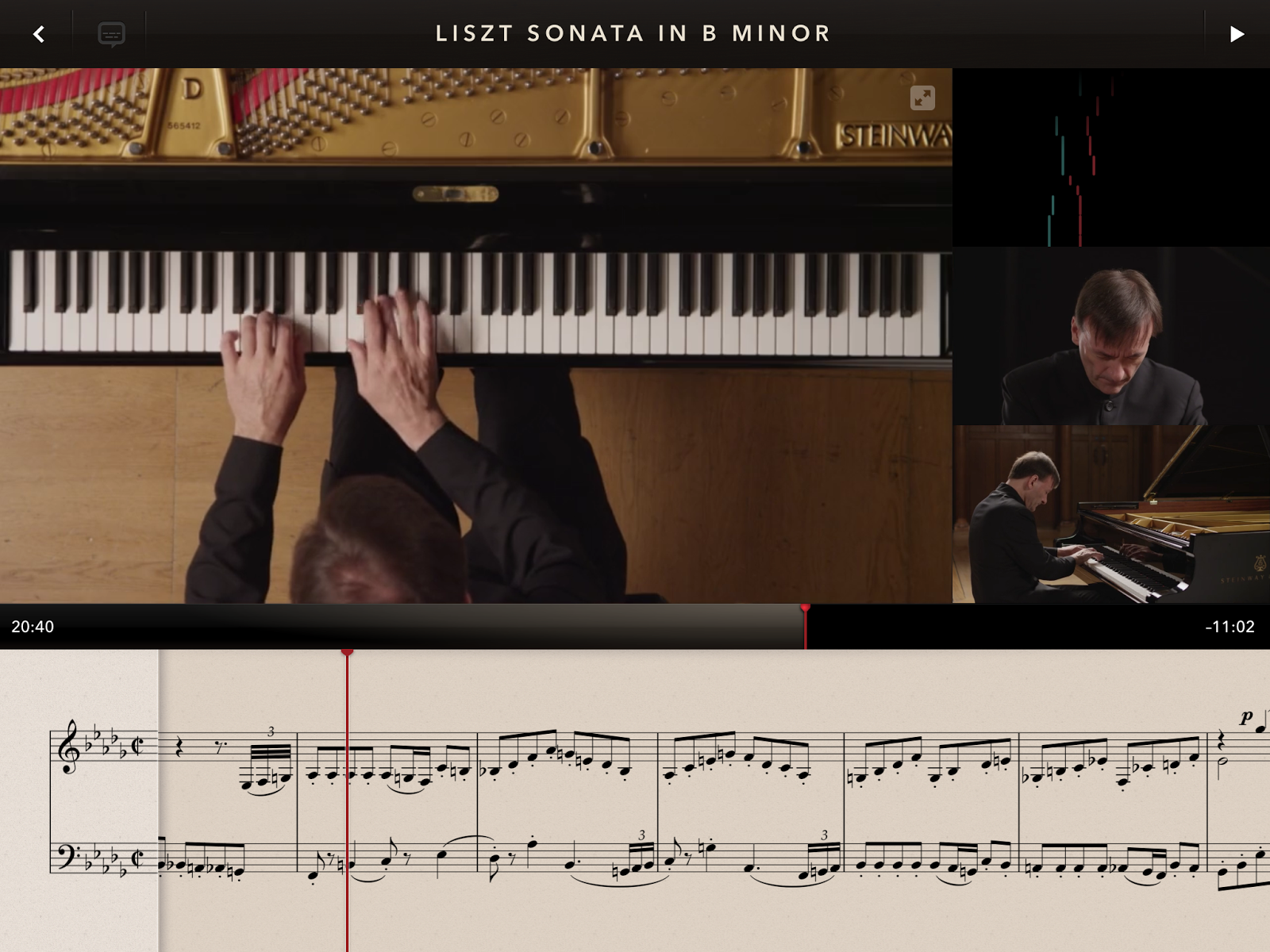
Bernard Stiegler in a 2010 article ('The Age of De-proletarianisation') refers to Bartók's 1937 lecture on mechanical music: "At the beginning of the 20th century, perception took a mechanical turn – making it possible, for example, to repeatedly listen to music without knowing how to make music. Bartók drew attention to this in relation to the radio, when he recommended only listening to music while following along visually with the musical score."

Stephen Hough has released a wonderful iPad app where you can do just that: the score is presented as well as three different camera angles filming the performance, and all of these play in sync and of course you can move freely around in the piece with the swipe if a finger. There is also an intriguing piano roll view which shows the notes of the left hand and right hand as little scrolling streaks in different colours.

Bartók was concerned with the body's role in the production of music, and to some extent echoed an aritcle in a special issue of Musikblätter des Anbruch on Music and Machines (October/November 1926) contributed by Hans Heinsheimer, who worked as a music publisher for Universal Edition (where he supported Kurt Weill, Leoš Janáček, and Alban Berg).

Stiegler asserts that "the socialisation of digital technologies, as with every new technology, is initially perceived as a kind of poison (as Plato said about writing, even though it was the basis of law and rational thought)." Perhaps we are too far steeped in the consumerist disenfranchisement from our lives to feel the poison at work: as Stiegler writes elsewhere in the same article ..."a good consumer is both utterly passive and irresponsible" He concludes with an injunction to grasp the digital nettle: "Like writing, and according to Plato’s word, the digital is a pharmakon, that is, at once a poison, a remedy and a scapegoat. Only the digital itself, insofar as it can be a remedy, enables an effective struggle against the poison which it also is"

Sunday, April 13, 2014

The real ogres know how to live


Claude Chabrol is the French Hitchcock. Of course, that's an Anglo-centric way of putting it. He may be better than Hitchcock. At the end of his film Masques the soundtrack even plays Gounod's 'Marche funèbre d'une marionnette' ... the piece used as the theme music for the TV series Alfred Hitchcock Presents.

In this film the sinister character at one point explains: "The love for children, you know, it's terrible ... it eats you alive! They're the real ogres."

Raymond Carver, in an essay on "Influence" in his book Fires wrote: "The biggest single influence on my writing, directly and indirectly, has been my two children. They were born before I was twenty and from beginning to end – some nineteen years in all – there wasn’t any area of my life where their heavy and often baleful influence didn’t reach."

I remember the first time I read this —back before I had any children of my own — this shocked me, maybe because — for like Tonio Kröger I am no doubt ein verirrter Burger — it was not the sort of thing one should say, it was not (in the young Tolstoy's terms) comme il faut, but I think also because — despite the admiration I felt for both the man and his writing — I sensed that here there was something wrong, something that revealed more of some ancient wound of the speaker than it did some universal experience.

Children are — almost by definition — a positive. They know how to live! In a scene at the very end of Mikio Naruse's Late Chrysanthemums one friend advises another whose adult son has just left on a train for a new job in a different city, "Don't worry, young people know how to live".

There are theories about creole languages — new langauges with sophisticated grammars arising out of the many-rooted pidgin languages in communities of immigrant workers of diverse origins — which explain that their creation is due to the children of the community playing together and inventing the new language. But surely the standard languages are similarly invented, or reinvented, children inventing a language based on the inherited dialect, but full of mistakes and radical reuse ... small wonder that reading Chaucer in the original is not so easy.

Friday, April 11, 2014

Problems of the will

"The real problems are the problems of the will" - the quote is from Giuseppe Mazzotta, in his book Reading Dante, but if like me you've watched his Yale lecture course on 'Dante in Translation' more than once, then you'll remember the idea. The full context of the quotation is this: "The body stands for one’s own reality, the passions. It stands for one’s own will. This is the difference between what the Greeks understand as the great intellectual adventure, which is one of knowledge, and Dante’s idea that the real problems are problems of the will. We may not know where we are, and we may understand that we are not happy with the situation in which we find ourselves, but we cannot quite solve these problems with knowledge alone because the problems here are problems of willing."

Dante himself was well aware of the centrality of the question of will in his Comedy. In his Epistle to Cangrande he writes: "Si vero accipiatur opus allegorice, subiectum est homo prout merendo et demerendo per arbitorii liberatem iustitie premiandi et puniendi obnoxius est" (If the work is taken allegorically, the subject is man according as by his merits or demerits in the exercise of his free will  he is deserving of reward or punishment by justice."[bold face mine])

And of all the great writers, who better to understand this than the "problem-gambler" Dostoevsky? But of course it may well not have been until his second marriage that Dostoevsky would actually have felt any 'remorse' at succumbing to the 'weakness' of being addicted to gambling. If the character Alexei in The Gambler is anything to go by, then the young Dostoevsky possibly had his own theories about success and the positive power of human will, although Alexei - like Raskolnikov with his similarly cerebral theories about crime - seems quite incapable of actually attaining the rational control he extols.

Novels are like symphonies: they unfold in a linear sequence, but their parts stand in architectural relation to each other; main themes are announced and explored through their developments.  Crime and Punishment, for example, after a brief introduction which introduces us to Raskolnikov's fevered stream of consciousness, announces a grand theme of the failure of the will as presented in the recounted history of Marmeladov, who has drunk up everything, lost all opportunity, and sinks further and further into wretched hopelessness. He has been reduced to living off the earnings of his daughter who has been driven to prostitution.  We, in a sense, overhear this as he recounts his pathetic story to Raskolnikov, much as Raskolnikov overhears a student and a young officer theorizing over the merits of murdering the old pawnbroker. Of course, it is not many pages after Marmeladov's story that we learn that Raskolnikov himself has been the financial beneficiary of his elderly mother who subsists on a meagre pension, and his sister who had had to take up a very unpleasant serving position; all this bears a striking resemblance to Marmeladov's own circumstances. So we are now left having to revise our suppositions about how Raskolnikov felt about Marmeladov's story; a new light is cast backward over the narrative.  This uncertainty can start to infest the text; when, for instance, Raskolnikov sleeps suddenly in the bushes, and then on the way home, before falling into a deep slumber from which he cannot be woken, he chances to overhear a conversation in the Haymarket with Lizaveta, the unfortunate sister of the pawn-broker, revealing the exact hour at which she will be absent from the apartment, could this perhaps be a delusion? It is paired with the story of Raskolnikov chancing to overhear the student and the young officer, who just happen to be talking of the pawn-broker whom Raskolnikov himself has just visited, and furthermore, they are discussing the very thoughts of murder that he was already apparently thinking himself. How reliable really is this narrator? It starts to feel like the delusional otherness of Fight Club.

Failure of the will is Raskolnikov's own analysis of why most crimes are so readily solved: he believes that almost any criminal, at the moment of the crime, "подвергается какому-то упадку воли и рассудка" - undergoes some failure of the will and reason.

Tuesday, March 18, 2014

Trifling details und ein neues Niveau

Nikolai Alexandrovich Yaroshenko's
painting 'The Student' (1881)
In Crime and Punishment (1866), Raskolnikov, after receiving some jeering comment in the street about his German hat (someone shouts at him "немецкий шляпник!") and realising how conspicuous it makes him, exclaims: Мелочи, мелочи главное!.. Вот эти-то мелочи и губят всегда и всё… (Trivial details, trivial details above all … It's these trivial details that ruin everything always).

Adorno posing with a musical score
Adorno also saw the power of trifling details: in Minima Moralia he writes "Keine Verbesserung ist zu klein oder geringfügig, als daß man sie nicht durchführen sollte. Von hundert Änderungen mag jede einzelne läppisch und pedantisch erscheinen; zusammen können sie ein neues Niveau des Textes ausmachen." (“No improvement is too small or insignificant to be carried out. Out of a hundred changes, a single one may appear trifling and pedantic; together they can raise the text to a new level.”).

Adorno, of course, understood music, and music is all details; as Emperor Joseph is reported to have said: Gewaltig viel Noten lieber Mozart!

Wednesday, March 12, 2014

Most anxious to appear clever

Усадьба Богимово, the setting of 'The House with the Mezzanine'
Chekhov in his story "The house with the Mezzanine" paints, in a single sentence, an instantly recognizable and convincing portrait of a young man who has retained the social awkwardness of his student days:
Chekhov, 1879
Зато мой  Петр  Петрович,  у  которого  еще  со студенчества осталась манера всякий  разговор  сводить  на  спор,  говорил скучно, вяло и  длинно,  с  явным  желанием  казаться  умным  и  передовым человеком.
On the other hand my friend Pyotr Petrovich, who still retained the student habit of turning everything into an argument, spoke boringly, listlessly and longwindedly - he was obviously most anxious to appear advanced and clever.
Tolstoy in Youth (Юность) presents himself as a young student with a similar social affliction in a memorably cringeworthy scene:
- Вам,  я  думаю,  скучно,  monsieur Nicolas,  слушать из  середины,  - сказала мне  Софья  Ивановна с  своим  добродушным вздохом,  переворачивая куски платья, которое она шила.
Чтение в  это время прекратилось,  потому что Дмитрий куда-то  вышел из комнаты.
- Или, может быть, вы уже читали "Роброя"?
В то время я считал своею обязанностию, вследствие уже одного того, что носил студенческий мундир,  с  людьми мало  мне  знакомыми на  каждый даже самый простой вопрос отвечать непременно очень умно и оригинально и считал величайшим стыдом короткие и ясные ответы,  как: да, нет, скучно, весело и тому  подобное.  Взглянув  на  свои  новые  модные  панталоны и  блестящие пуговицы сюртука,  я отвечал, что не читал "Роброя", но что мне было очень интересно слушать,  потому что я больше люблю читать книги из средины, чем с начала.
- Вдвое интересней:  догадываешься о  том,  что  было и  что  будет,  -
The young & unpleasant Tolstoy

добавил я, самодовольно улыбаясь.
'I expect you find it dull, Monsieur Nicolas, to hear the middle of the story without knowing the beginning,'  said Sophia Ivanovna to me with her good-natured sigh, turning over the pieces of a garment she was making.
The reading had stopped just then because Dmitri had gone out of the room.
'Or perhaps you have read Rob Roy before?'
At that time I thought it incumbent on me, if only on account of my student's uniform, always to give clever and original answers to even the simplest question put to me by people I did not know very well, and I should have been deeply ashamed to offer brief plain replies like 'Yes,' 'No,' 'I don't care for it,' 'I like it,' and so on. With a glance at my fashionable new trousers and the shining buttons on my coat I said that I had not read Rob Roy but that it was very interesting to me to listen to it because I preferred to read books from the middle rather than from the beginning.
'It is doubly interesting,' I added with a self-satisfied smile. 'One tries to guess what has gone before and what will happen further on.'
Youth p. 242 sect 23

Then in his story 'Muzhiki' (sometimes translated as 'Peasants'), Chekhov describes a character whose only achievement is the acquisition of a few unusual words.
В городе он не живал и книг никогда не читал, но откуда-то набрался разных умных слов и любил употреблять их в разговоре, и за это его уважали, хотя и не всегда понимали.
Although he had never lived in a town or read any books, somehow he had managed to accumulate a store of various clever-sounding words and he loved using them in conversation, which made him respected, if not always understood.
How many writers still it these shoes? The awkward youth eager to impress? The ill-educated spicing every paragraph with clever-sounding words? People like me peppering obscure blog posts with quotes in multiple languages.